
A Boy and His Frog
A Review of Blaster Master on the NES

It was a good time to be a kid during the NES era. Each new game introduced innovative mechanics I’d never experienced before. I vividly remember when my brother’s friend brought over his NES games and showed us Blaster Master (aka MetaFight in Japan). I was immediately captivated as the story elements unfolded in the prologue, accompanied by melancholic music.
Pressing the start button then leads to the scene of an armored tank rocketing away. The triumphant music swells as the hero embarks on an adventure into the unknown. At the time, nothing like it had ever caught my attention. Though modest by today’s standards, Blaster Master still features many characteristics that remain enjoyable.
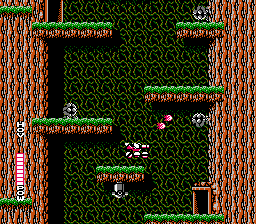
The story follows Jason and his pet frog Fred. One day, Fred escapes into the forest and hops onto a radioactive chest. Jason watches as the frog enlarges to an enormous size and becomes so heavy that it falls deep underground. After falling into a hole while trying to catch Fred, Jason discovers a vehicle called “Sophia the 3rd”—an all-terrain battle tank capable of all manner of traversal. He jumps into the tank, determined to find his amphibian friend.
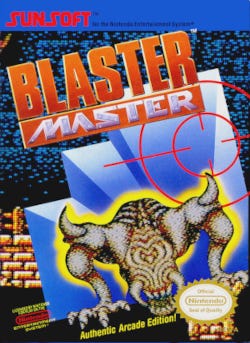
When one generally thinks of a tank in video games, perhaps the mind conjures an image of a plodding lummox of a vehicle ill-equipped for a 2D platforming adventure. But the Sophia tank offers a refreshing change from the usual. It can jump and maneuver through terrain with ease. You’ll be speeding through underground caverns in a nimble, fast-firing armored vehicle that lives up to the “authentic arcade edition” label on the game box.
You navigate a vast underground world, steadily acquiring upgrades that unlock access to previously unreachable zones. This can also lead to getting lost while trying to find the next boss or area until you establish your bearings. Initially, most of your exploration in the first few sections of any area is done in the tank. But eventually, Jason will have to step out of the tank to access the sub-levels and other areas too small for the tank to fit through.
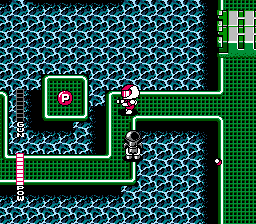
While he can explore the regular overworld, he can’t survive high falls and is especially vulnerable to enemy fire in the side-scrolling areas. However, he can replenish his energy by jumping into his tank again—a feature I wish was present in more games like this.
When you enter the sub-levels, the perspective changes to a top-down viewpoint. There is no platforming involved in these sections, but there are plenty of enemies to destroy in the general vicinity. The sub-levels are necessary to explore to find the boss for each area and gain the upgrade needed for the tank. Upgrades include a more powerful cannon, the ability to hover, and eventually climb walls and ceilings.
Jason can also find upgrades for his pea shooter gun that will make it much more proficient at quickly disposing of the enemies that stand in your way. In addition to Jason’s gun, he also has an infinite supply of grenades that are most useful against stronger enemies and bosses. When you’re done fighting a boss, you are taken back to the entrance of the sub-level so you easily make your way out. Sunsoft did a good job of making the two main aspects of the game seem equally as important, instead of just a tacked-on gimmick.
The game’s art designer, Yoshiaki Iwata, commented in a 2010 interview that they “wanted the player to experience the feeling of excitement that comes from discovering something after endeavoring through a difficult search. [They] wanted the player to have to struggle”1. Well, mission accomplished, design team!
While easy-going in the opening moments of the game, that facade quickly dissolves the minute you leave the protection of the tank and send Jason into the sub-sections that only he can explore. With enemies appearing so quickly, especially when moving between rooms, you can get clipped by a stray bullet or unintended physical contact with an enemy.
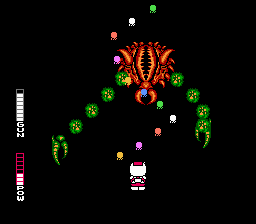
In addition to taking health damage, Jason’s gun loses power with each hit. This makes for a very frustrating experience when trying to survive the lengthy sections in later parts of the game. And the end-level bosses? Forget about it. Assuming you don’t abuse the grenade glitch on several bosses, these parts of Blaster Master in particular seem more like battles of attrition with the scales tipped in the enemy’s favor.
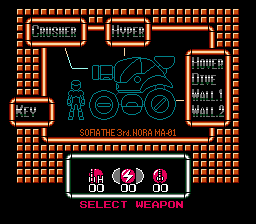
Unfortunately, the tank (as well as Jason) is afforded little to no recovery time when taking damage from enemies. This makes accidental contact a nightmare in most sections since your health bar quickly drains when taking repeated hits. Especially annoying are the smaller ground enemies that can quickly catch up to you and keep pace with your tank in the side-scrolling sections.
Another problem is that most enemies pop up suddenly in view from the edge of the screen. It can be particularly problematic when jumping up vertical spaces since it gives enemies on ceilings a cheap advantage over you, as you often get surprised by their attacks.
The game also has the annoying habit of turning your powers into a liability once you acquire the final upgrades that allow your vehicle to climb walls and stick to platforms. It’s especially troublesome during the final area where spikes surround everything. Worse yet, enemies are positioned in such a way that you are all but guaranteed to take a cheap hit thanks to the clumsiness of the tank sticking to surfaces instead of gently rolling off the platform as you could do before acquiring the final upgrade.
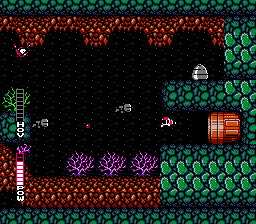
Besides its easy-to-learn but hard-to-master gameplay elements, Blaster Master is often praised for its musical score, and for good reason. Every area’s background music fits the visual theme of that location. Whether it’s the exploratory and courageous tune of the initial caverns or the breezy sounds of the aquatic area, the music never gets generic. My personal favorites are the music for areas 1, 2, 3, and 5. You will find yourself less concerned with the length of the game, and more in tune with the audio presentation.
Overall, the game has the hallmarks of a true NES classic. The platforming elements are spot on, the controls are highly responsive, and the soundtrack is nothing short of brilliant. Blaster Master feels like a refined version of Metroid, having learned most of the right lessons from that game.
While you could track down the NES cartridge fairly easily, I recommend playing it via the Nintendo Switch Online service. The quality-of-life improvements of the rewind function and ability to save your progress at any time make the NSO version the quintessential experience. But no matter how you choose to play it, Blaster Master is a game you’ll enjoy if you’re a fan of old-school action platformers.
Source: https://web.archive.org/web/20110713202800/http://www.levelfortytwo.com/2010/06/interview-with-the-creator-of-blaster-master/
Blaster Master was one of my favorites of the era, even though I was never able to totally beat it back then. Every time I got a tiny bit further it felt like I had unlocked a whole new game, but some of the backtracking and gauntlets are really rough, even for the time.
It's also one of the series I was most sad to see kind of vanish - there were a few spinoffs and reboot attempts, but until the Inti Creates trilogy started it was pretty much abandoned. That Zero trilogy is pretty solid on its own, though it has its own flaws, but there's one thing it introduced that I feel is just such an obvious and simple fix for the Gradius Syndrome problem so many games like it have where every hit also makes it harder to not get hit [by making you weaker, thus forced into longer combat or more risky combat] - they gave you an [optional] single-hit, regenerating shield, but not for your health, just to prevent you from losing gun power unless you take multiple hits too close together. So it's still a risk, you still have to play well, and gun power remains useful as a drop, but you don't feel like you've gotten punched in the face every time there's a wonky hitbox or something. Every game with a similar system should add something like that.
Blaster Master is one of those old games that seems to be stalking me, begging me to play. I've read about it over and over, again. But, the negatives you mention keep me away. You're right about the benefit of using an emulator or whatever system with save states. I was only able to finally beat one of my first rivals, Ninja Gaiden, that way.
The concept is interesting...though I would hope there's more to the story than just chasing down a mutated frog in a mysterious tank that just sits in an underground hole.
I'd say this is more like Broderbund's The Guardian Legend than Metroid. TGL is noted for great music and has the game divided between vertical scrolling (flight) sections and four-way top-view map exploration with weapons of varying strength.