
It's Adventure Time!
A Look Back At The Legend of Zelda

Genre: Action/Adventure
Number of Players: 1
Developer: Nintendo R&D4
Publisher: Nintendo
Release Date: February 21, 1986 (JP), August 27, 1987 (US), November 15, 1987 (EU)
Platform: NES
Also Available On: GameCube, Game Boy Advance, Nintendo Switch Online

With its deceptively easy gameplay and deep exploration, The Legend of Zelda marked several firsts for Nintendo and for the video game industry. It was one of the first Famicom Disk System games to hit Japan on this day in February 1986, offering the ability to save progress without the need for a password system.
When it debued North America in 1987, it was released on a golden cartridge featuring a small backup battery to save progress—making it the first game to use the technology. But most importantly, it was the first game to truly revolutionize the action/adventure genre with elements that would be borrowed from (and ripped off) for years to come.
This game, much like Mega Man 2 and Super Mario Bros., has been reviewed, praised, and worshiped to death. If you pay a visit to any retro gaming websites, you’ll be hard-pressed to find a write-up that doesn’t drool over the genre-defining legacy that series creator Shigeru Miyamoto established. There was once a time, however, when Miyamoto was not a name familiar to most NES owners—despite having played several of his previous games—and The Legend of Zelda was just a game starring a kid wearing a funny green hat.
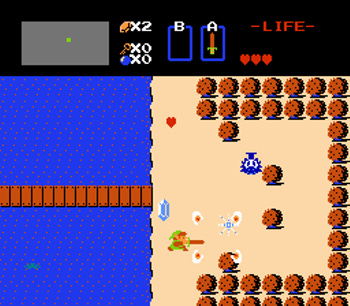
Our story begins in the kingdom of Hyrule, where Ganon has stolen the Triforce of Power and plans to plunge the world into darkness under his rule. Princess Zelda split the remaining Triforce of Wisdom into eight fragments and spread them throughout the land to prevent Ganon from getting his grubby hands on it. In retaliation, he imprisoned Zelda, preventing her from interfering with his plans. It’s up to Link to find the pieces of the Triforce of Wisdom, defeat Ganon, rescue Zelda, and restore peace to Hyrule.
You’ll guide Link as he travels between the Hyrule overworld and nine dungeons that house the pieces of the Triforce he needs to collect. Above and below ground are filled with now-familiar enemies such as the rock-spitting Octoroks, spear-happy Moblins, shield-eating Like Likes (which nobody likes), and downright creepy Wallmasters, all of which got their start here.
The game features a simple but effective fighting system. At all times, Link has access to his sword (obtained in a cave near your starting position) and shield. When his health is at full strength, Link can throw his sword across the screen, which is great when you want to keep your distance from the enemy.
As you progress through the game, you’ll collect an abundance of secondary items—many of which are invaluable additions to your arsenal. The boomerang is a perfect example: once obtained, you’ll have an easier time fighting multiple enemies because you can strategically stun [most of] them and then finish them off with your sword.

Other items, such as the bow and arrow, bombs, and many others (too many to mention here) remain relevant throughout the duration of the game. When first playing through the game, I was quite surprised by how integral the secondary items were to completing the dungeons.
Link automatically has his shield at the ready when you’re not attacking with the sword or certain other secondary items. Thankfully, it deflects objects like spears and stones, making the shield more than just cosmetic to Link’s character sprite.
Both the shield and the sword can be upgraded to better serve your offensive and defensive needs. The Legend of Zelda offers you the flexibility to finish it without ever upgrading your equipment; however, it’s much more enjoyable once you find the various upgrades.
What I found interesting was the surprising sense of accomplishment that comes so early in the adventure. You feel like a real winner with the now-famous “item catch” fanfare that plays when doing simple things like obtaining Link’s basic sword, getting the ladder, or collecting a letter to give to a certain old lady.
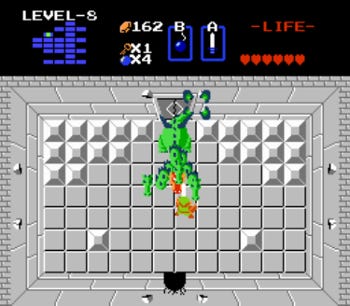
But that was nothing compared to the feeling of grandeur after collecting a Triforce piece. When I played this for the first time in 2002, I remember briefly thinking I had won the game after completing the first dungeon, thanks to the appropriately triumphant music. The Legend of Zelda is a game that wants you to savor the victory.
The nine dungeons are fairly well designed, with a compass and map hidden within each to guide you to the Triforce piece housed therein. Interestingly, these two helpful items don’t completely take the mystery out of exploring the dungeons. Certain doors are accessible only after all enemies in the current room are defeated. Some stairways are hidden until you push a block in the correct direction to reveal that room’s secret.
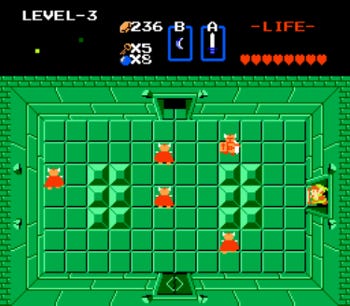
Best of all, the enemies and bosses guarding the Triforce often have unique weaknesses that need to be exploited to defeat them. And even after you learn the weaknesses of your enemies, most still need to be approached with caution, or you can find yourself in a perilous predicament very quickly. I still get a little nervous when I’m low on health and have to fight a room full of Darknuts.
With all of the admirable qualities that can be found in the inaugural Zelda title, there is one aspect that didn’t age quite as gracefully—the non-linear approach. Or rather, I should say that it was the execution of the non-linear approach. After all, it’s great that you’re not forced to attack each dungeon in a strict order, and you are free to roam around Hyrule to your heart’s content. But when it comes time to hunker down and finish the quest, things can come to a screeching halt once you realize that you don’t know what the heck you’re supposed to do next.
Sure, you’ll get occasional cryptic clues from old people in caves and dark rooms. But am I really supposed to know that some guy telling me that “Spectacle Rock is an entrance to death“ is creepy-old-man-speak for “place a bomb on one of the otherwise innocuous boulders somewhere at the top of the overworld map to access the final dungeon“? No way.
You can expect to find stellar advice like that throughout the game. And while the difficulty may have been just right back when people cared if you beat a game on your own or not, it simply doesn’t matter much nowadays to the average player who is more interested in finishing the game than winning the admiration of his school buddies.
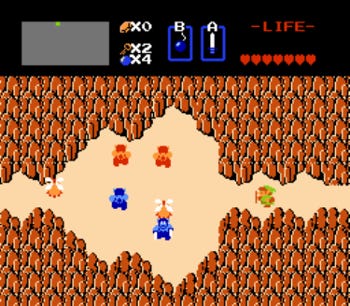
The visual style, while quite primitive by today’s standards, was perfect for its time. The creatures that inhabit the land of Hyrule were quite unusual compared to the usual line-up found in most fantasy adventure games back then. I had never known of any other game (at the time) that had characters quite as unusual as the floating Peahat or the odd-looking Pols Voice.
Exploring each area is quite enjoyable, thanks to smooth screen-to-screen scrolling. I also liked the way Link was engulfed in a black backdrop every time he found one of the Triforce fragments. It really amplifies the feeling of a job well done each time you complete a dungeon.
To say the audio in The Legend of Zelda was good would be a bit of an understatement. What’s ironic is that there isn’t much variety in the way of multiple musical scores. There are really only two main pieces of music that play throughout the majority of the game: the overworld and dungeon themes. Even so, they are catchy tunes and make for the perfect accompaniment to the action. The music for the overworld sections has become a ubiquitous feature throughout the life of the Zelda series. The sound effects are also quite memorable as well, especially the whistle, whose sound later made its way into Super Mario Bros. 3.

The Legend of Zelda has become a well-respected, venerable series for good reason. This first game of many solidified the action/adventure genre and provided an unforgettable experience for anyone willing to devote their time to exploring the land of Hyrule. There were no menu commands to sort through, and no level-up system to dictate the growth of your character. Instead, the game featured the simple use of a sword and shield and left the rest up to you.
Just keep in mind that the game will not hold your hand with regard to where to go or how to accomplish certain key objectives. So don’t be ashamed to whip out the strategy guide or consult GameFAQs if need be. It’s well worth the time if you’re interested in seeing the series’ humble beginnings.
I really appreciate your perspective on this! I also agree that, despite being a great game for its time, this initial open world approach hasn't aged as well as the subsequent games in the series. That's why I'm a fan of hacks like the Redux series, which enhance the best elements of those earlier Zelda titles with some much-needed quality of life improvements.