
Training Day
A look at Hogan's Alley

Genre: Light Gun
Number of Players: 1
Developer: Nintendo R&D1/Intelligent Systems
Publisher: Nintendo
Release Date: June 12, 1984 (JP), October 18, 1985 (US), December 15, 1987 (EU)
Platform: NES
Also Available On: Arcade
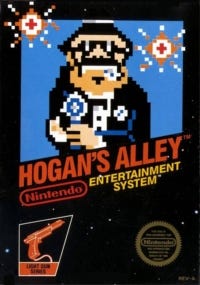
I knew very little about Hogan’s Alley back in its heyday. Judging by the mean-looking gangster fully armed with a gun and grimace on the front cover, I assumed it must have been some 3D action title featuring all sorts of wanton violence that my impressionable mind couldn’t handle. However, as the years passed, I eventually learned the less sinister purpose of this game. Originally released in 1984 in Japanese arcades, Hogan’s Alley was a simple target practice game somewhat modeled after the real-life Camp Perry National Guard training facility of the same name.
The game featured no serious allusions to heavy violence. Instead, it only had what were essentially cardboard cut-outs of targets to test your shooting skills. A year later, Nintendo made it a launch title for the North American release of their NES console. This game taught me a lot about myself. Apparently, I’m a trigger-happy loose cannon that will open fire on just about anything.
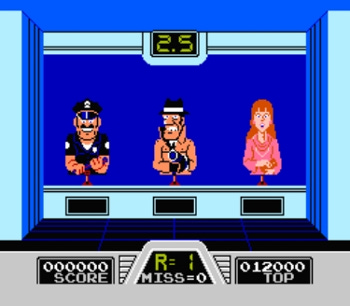
I never thought that a game could force me to call into question my ability to identify and shoot a few targets. Hogan’s Alley forces you to hone both your marksmanship and quick judgment skills. You are placed in a training facility that houses cardboard cutouts of six individuals. Three of the six are the targets you want to shoot—Gangster A, Gangster B, and, you guessed it, Gangster C. The other three characters are the innocent civilians that you’d best not shoot—the Lady, the Professor, and the Policeman. Shooting a civilian or failing to shoot the gangster(s) onscreen counts as a “miss” against you. Get 10 misses, and it’s game over for you.
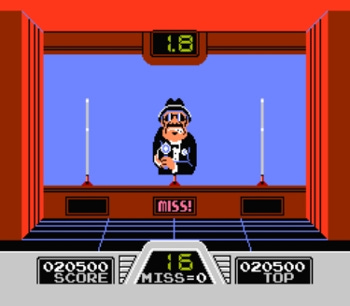
In the same vein as other early NES light gun games, Hogan’s Alley is made of three parts-- Game A, B, and C. Game A is a simple shooting range where each round consists of a mixed lineup of 3 characters. Your goal is to quickly identify and shoot the gangsters in the lineup. Naturally, there will be civilians in the lineup as well, so care must be taken not to shoot them. The numeric figure above the characters represents how many seconds you have to hit to correct targets. This is where much of the challenge is presented.
At first, you’re allowed 2.5 seconds to hit your targets. But soon, the game starts getting tricky by giving you only 0.6 seconds to shoot two gangsters. Short time constraints always make me nervous, and I end up hitting only one of two targets, or worst yet, shooting a bystander. The other major challenge involves not confusing a civilian for one of the bad guys. This is especially so with the Professor and Policeman, as they wear the same color of clothing as two of the gangster cutouts. On a good day, I can make it to round 48 before I have to do the walk of shame.
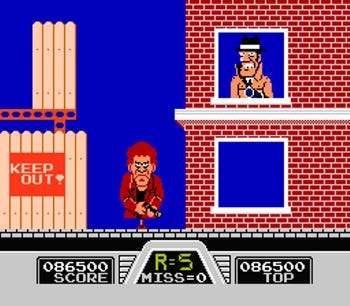
Game B is more involved than the former one. In this mode, you have to deal with both fixed and moving targets, but the same rules in Game A apply here. In Game B, you are placed in an urban scenario where gangsters and civilians move between buildings, windows, and the pavement. Each round consists of five scenes where both quick wits and an itchy trigger finger are required to succeed. This game mode also adds the additional wrinkle of having multiple targets moving at different intervals.
I tend to prefer the Game B mode because it becomes even more challenging than just picking through a lineup. Again, it is all too easy to accidentally shoot a civilian, so you’ll have to be extra careful. If there’s one complaint I have about both game modes, it’s that it sometimes feels like the Zapper’s trigger doesn’t register as fast as the game demands when I’m trying to quickly shoot two targets.
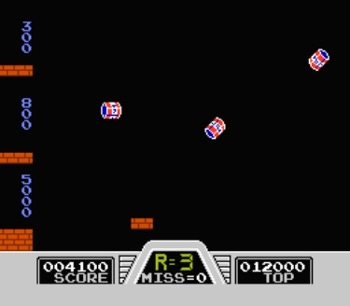
The final game mode, Trick Shot, is mostly just a bonus game mode. In this mode, cans are tossed onscreen, and you have to get them to land on one of the platforms on the opposite side by shooting them to keep them in the air long enough. You are awarded points according to which platform the cans land on—the highest platform awarding the fewest points, and the bottom platform yielding the most points, since it takes a skilled shot to land them there safely without missing. As with the other two game modes, you are allowed up to 10 misses before the game is over. While it doesn’t amount to much in the form of excitement, it’s still a nice diversion, should your brain tire of the shoot/don’t shoot exercises from the other two modes.
The graphics aren’t as impressive as future NES light gun games. Everything is very simplistic-looking and standard early NES fare. However, compared to games like Duck Hunt, Hogan’s Alley does have a bit more going for it. It can best be observed in Game B, where the scenery changes just enough to keep things visually interesting. Every two rounds, the color palette also changes to keep things from feeling too repetitive in a short period of time. Of course, that only goes so far these days, but it was nice to see the development team attempt to create some diversity with the scenery this time.
There isn’t much going on with the audio presentation in the way of music. Like other early NES games, you get a quick ditty that plays at the title screen, as well as a few notes that play every so often when advancing to another round. However, it’s really not a problem because the lack of music helps with concentration. Sound effects play a bigger role, especially in Game B, because you have to listen out for moving targets and enemies that suddenly pop out from the shadows. It works to great effect since you won’t be conflicted between listening out for movement and hearing some quirky tune playing in the background.
While better shooting gallery games have been made since the release of this one, Hogan’s Alley is still a worthy entry in the NES light gun series. Underneath its simplicity lie gameplay elements that would likely challenge even the most seasoned players. If Duck Hunt was a little too easy for you, then Hogan’s Alley might be a better fit instead.
I'm just curious, how are you playing Zapper games these days? Are you playing on a CRT with original hardware?
I enjoyed the review. I owned this one and liked it OK, but I guess I always preferred Duck Hunt as a kid. Later I discovered Wild Gunman. The latter is very simple, yet still kind of addictive to me.
I don't own a CRT and realistically don't have space to keep one. Yet I didn't want my kids to miss out on the joys of light gun games, plus they enjoy them so much at the arcades, so I picked up a Sinden Light Gun earlier this year to play them at home emulated via Batocera. It works reasonably well, but not nearly as carefree as just plugging a light gun into original hardware in the old days.