
Bowling Down Memory Lane
A Ten Pin Alley Review

Genre: Sports
Number of Players: 1-6
Developer: Adrenalin Entertainment
Publisher: ASC Games
Release Date: November 30, 1996 (US), July 1997 (EU)
Platform: PlayStation
Also Available On: Sega Saturn, Windows PC
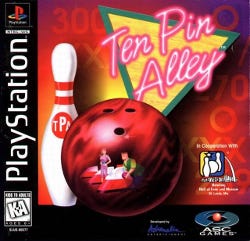
Of all the sports simulations to have existed since the success of Pong, bowling wasn’t something I thought I’d see in video game format in my adolescent years. Not because I didn’t think it was possible. Bowling just didn’t register in my consciousness as a sport that had a video game counterpart. It didn’t help that between 1985 and 1996, you could literally count on one hand how many bowling games were released on platforms like the NES, Genesis, Game Boy, and Super NES in North America.
Higher-profile sports games like football, basketball, baseball, heck…even pool got more attention in the home console space. It’s no wonder that bowling was an afterthought for me. Apparently, it was an afterthought to game developers too. That all changed for me one day when Big Brother stopped by the local game store after work and brought home Ten Pin Alley on the PlayStation. As we selected our characters and hit the lanes, I soon found myself wondering how I went this long without ever playing a bowling game. Oh…right.
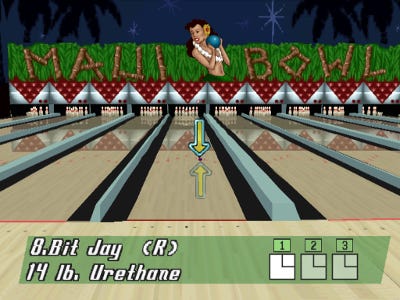
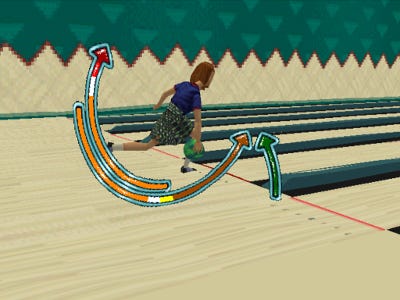
The act of bowling is broken down into three basic steps: (1) aim by moving the cursor over the desired lane arrow, (2) line up the character, and (3) use the bowling meters to determine the velocity (backswing) and release (forward arm motion) to take the shot. You can also use the spin meter to determine how much of a spin you want to put on it before releasing the ball.
The UI for the bowling meter was well thought out, as it was designed as a curved pendulum, which best simulates the basic arm motions when bowling. The player only needs to tap a button at the right time, as indicated by the yellow line on the bowling meters when determining the player’s backswing and release.
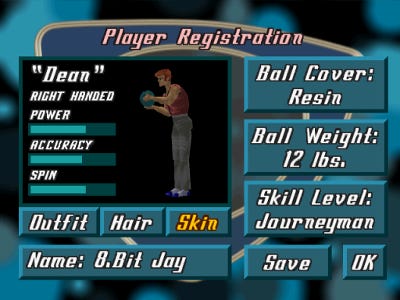
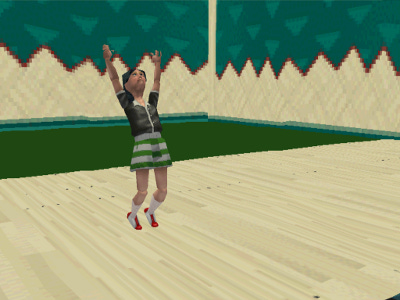
You can select and customize one of 12 characters, most of which look like they were plucked from the 1950s. Each character has their oftentimes humorous reactions when they bowl a strike, gutter, or fail to get the ball down the lane at all. Such characters add an amusing sense of whimsy to the game. Some are also left-handed bowlers, ensuring there’s someone for everyone, depending on your preferred method of bowling.
The authenticity of Ten Pin Alley shines through in that, while bowling a strike isn’t effortlessly easy, it can be done by novices and experts alike. The aiming cursor and player position reset on each attempt, requiring you to reorient yourself. This, in turn, makes it impossible to simply autopilot and stay in the perfect spot with the exact amount of spin on the ball needed without giving any thought to each variable. The satisfaction of hearing the crash of the pins as they topple over for a strike is palpable, as is the dread of attempting to bag a spare from a 7-10 split.
The physics governing how the pins react to the bowling ball’s weight, speed, and angle of impact is quite realistic. And as simple as operating the bowling meter may be, there’s always a slight chance you could tap that button just a hair too soon or too late, making for a less-than-perfect shot. The best part is that none of this makes the game unfair or punishingly difficult. Each time I didn’t get the results I had hoped for, it genuinely felt like it was my own error rather than obtuse game design.
As a bowling game, Ten Pin Alley is a natural choice for friends looking for multiplayer fun. Up to six people can play at once if you have the PlayStation Multitap peripheral handy. During multiplayer matches, the game allows players waiting for their turn to troll the player currently bowling. This can be done by holding down the four shoulder buttons and pressing any of the four face buttons, causing an unseen spectator to blurt out obnoxious jeers. For what it’s worth, you can also troll the CPU-controlled opponents, but it seems to have no direct effect on their performance.
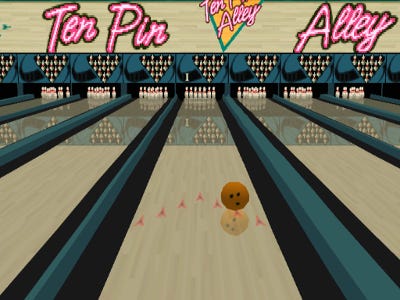
Most of the gameplay elements are simple enough to figure out without the need for a tutorial. However, there is a noticeable lack of information regarding several small but important details as they relate to other variables you may need to account for. Take, for example, the option to choose one of three cover types for the bowling ball—resin, plastic, or urethane. You can switch between them at any time during a match, but neither the game nor the instruction manual clarifies how each cover affects the performance of the ball.
To be clear, in real-world bowling, the ball does react differently depending on its coverstock and lane conditions. But to a layman player like myself who doesn’t actually know the difference, it’s hard to discern what it means within the context of the game. As far as I can tell, the differences between plastic, resin, and urethane are only cosmetic.
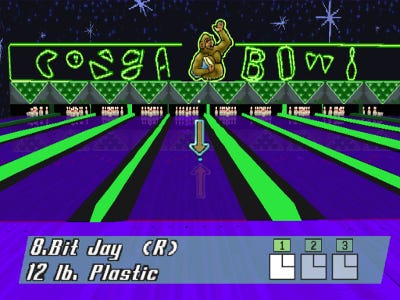
Yet, the fact that the CPU opponents keep switching their covers throughout the match instills a nagging doubt that maybe I’m not playing up to my true potential since I don’t know how (or if) the cover material matters. It’s like the game is hinting to you that the choice could indeed help or hinder your performance, but it doesn’t make it overtly clear. While none of this egregiously compromises the overall experience, it feels like a missed opportunity to provide a little more context to the choices presented to the player, given the realism that permeates throughout the game.
The visual presentation holds up reasonably well where it counts the most—the overall look of the environments. You have a full view of the lane from behind the shoulder of the player when lining up your shot, taking much of the guesswork out of aiming. You can choose from three types of alleys—Ten Pin Alley (modern), Maui Bowl (retro), and Conga Bowl (neon lighting). While I did enjoy the different aesthetics of each venue, the Conga Bowl is a little too dark for my taste. It obscures the floor’s lane arrows when positioning your player. Also, the character models aren’t great, even by 1996 standards.
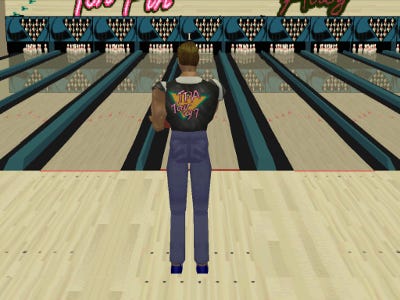
Considering that this was developed in an era when most PlayStation games were eager to show off as much 3D as humanly possible, Ten Pin Alley shows a measure of restraint by keeping the focus only on the immediate playing area. You have the lane arrows and signage you’d expect to see at each bowling venue, doing a fantastic job of creating a convincing facsimile of the sport. It doesn’t stretch itself thin trying to recreate an entire bowling facility, and instead puts that energy into realistic bowling physics.
For music, the player can choose between Lounge or Rock tracks (all instrumental without any vocals) during exhibition games. The sound quality is on par with what one would rightly expect from an early PlayStation game. I find the Lounge songs to be the most memorable, though it may be due to the countless gameplay sessions I’ve had over time.
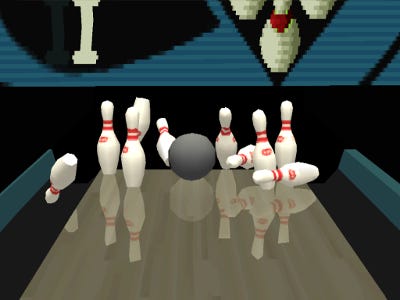
Much like the central gameplay mechanics, the audio presentation rings true to the typical bowling experience. The background chatter of other patrons and the sounds of pin strikes echoing from lanes off-camera capture the atmosphere of the bowling alley. The authenticity particularly shines when playing tournament matches. There is no music to be heard whatsoever. The matches are all but silent, with only muffled whispers and the occasional cough from the audience.
The ability to blurt out those obnoxious jeers mentioned earlier during tournaments is thankfully also disabled in this mode. Bowling a strike or spare garners applause from onlookers. In moments when you almost get a strike, but that one pin teasingly wobbles and decides not to fall, the crowd audibly agonizes with you. With that kind of ambiance, it almost feels like you’re playing in a real-life pro competition.
Ten Pin Alley aptly reflects the development team’s understanding and respect for the fundamental aspects of competitive bowling—whether it’s just family and friends hanging out, or professional bowlers going for the winnings. The game was even sanctioned by the National Bowling Hall of Fame & Museum (featuring a promo video accessible from the main menu), giving it a bit of extra credibility for bowling diehards.
I especially appreciate the game’s restraint in not playing music during tournament matches. It’s something that could have been ignored for fear that players would find it boring. On the contrary, it adds to the richness of the experience, making this a game that has the potential to appeal to anyone willing to give it a chance. Its accurate portrayal of lining up a shot and the physics that followed puts Ten Pin Alley head and shoulders above any home console bowling video game that came before it.
This sounds like a game I would have played with my parents. Wii Sports bowling was a huge hit in my house and I can see this being the precursor! I really admire their commitment to the game with the silence in tournaments and the different covers for the balls, that’s detail no one needed but some will appreciate!